



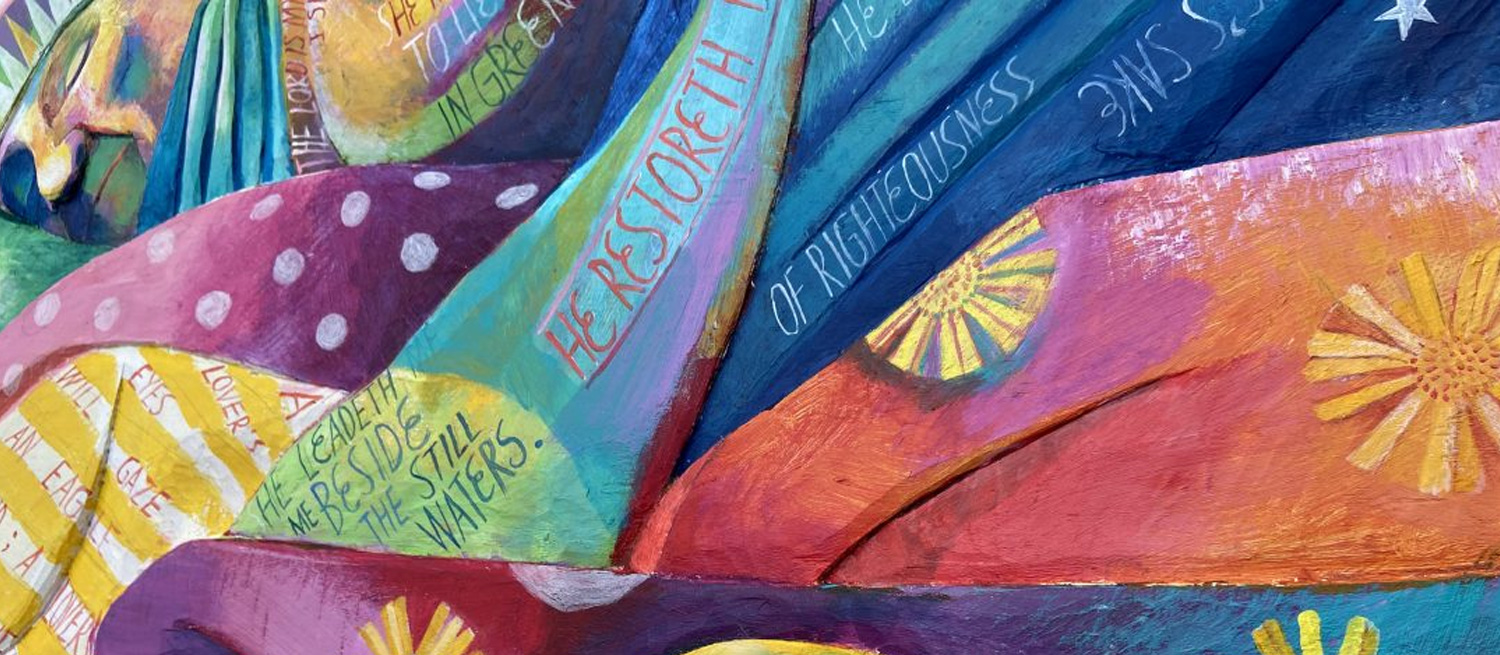
I hope you have noticed Lynne Mcilvride’s art on display in our Allan Beattie room. She is hosting a reception at which I will interview her about her work this Saturday from 1-4pm with the interview at 2pm.
Learn more about her faith and art here.
The first thing I notice about your work is how colourful it is.
Colour is the hardest thing for me to talk about because it’s so natural, it’s just part of what I do, so I’m like a fish talking about water. Designs are things I work out carefully, but when it comes to colour, I work intuitively. I find it joyful. I like the way colours interact with one another. It’s like hosting a dinner party: you say ‘Ok, he’s interesting, what would he be like beside her?’ I hope it’s beautiful, but it’s not always pretty, or what some people would call “tasteful.” I like bizarre colour combinations to see what happens.
How long have you been an artist?
As long as I remember. I didn’t come from the kind of family that went to galleries, so it wasn’t until high school that I realized there was such a thing as an “artist,” even though I was doing it since I was 3.
Most of us get discouraged and quit.
That’s too bad. Children’s art is the best. Everyone’s fantastic when we’re children. But people change, and teachers are not always helpful. I was destined to be an artist.
How do you think about God in your work?
I do see this as a welcome gift from God. It used to be easier to talk about my faith and art. I don’t know why. Maybe it seemed simpler then? Or did I just talk about it more? Maybe ask something more specific I’ll be able to talk about it.
When do you notice God at work through your work?
I don’t only think of my art as a gift from God. I also think of doing art as a person of faith as giving a gift to people. Like offering flowers to the world. I think of art-making as an act of generosity to others. It’s a gift from me to the world. Not that I don’t want to, I do. But it’s a gift of love.
Some might say that constricts you and your work.
No (laughs). My work is a gift of love, but who cares if anybody likes it?! Perhaps this is the difference between something being beautiful as opposed to merely pretty. I’m doing things for the love of the person but not so that they’ll like it necessarily. It’s what they need anyway.
Like a physician might say about medicine that tastes bad or therapy that hurts?
That sounds a little harsh. I do care in some ways, but an artist’s job is to not care. It’s really important to work out of who you are as an artist and change as little as possible when find out what people are going to buy or applaud you for. There are so many dangerous voices you don’t want to listen to. Like little children’s art, it’s a gift to the world, but it doesn’t necessarily look like it’s “supposed” to be or look nice on a wall. Art is more basic and important than that.
The exhibition at TEMC features your late partner Ken Welsh quite a lot.
When he was sick and I was one of his main caregivers, I was drawing him. There’s a lot of not- doing-a-whole-lot besides-being-with so I was using that time to draw him. I wasn’t necessarily going to do anything with those sketches. But when he died, I took them into my studio, not knowing if anyone would ever see them, though they were very valuable to me. And I thought maybe I’ll make one of them into a painting. So I blew one up, added some things, and made one large watercolour of him. It was ok, I guess, but not right. It was on paper, so it needed a frame, which gets between the viewer and the work.
I wanted something more like caregiving: you actually carry someone around. I wanted work you could touch—something more tactile than watercolour under glass. When you carve wood by hand and then paint it, you’ve touched it a lot. I enlarged the sketches and turned them into painted basswood relief sculptures, and that’s where whole series on Ken came from. He’s mostly sleeping or resting in bed.
The body of work seems to me very cocoon-like, which seemed appropriate. He was about to be turned into something else.
How did you train to be an artist?
I went to York University for visual art. I was taught in the 1980s by professors who were taught in the 1960s, and therefore were not into teaching anything like a skill. So that was not helpful. But it was invaluable because I was from a little town and not exposed much to art. So it was important to me to see different ways of being an artist. I realized that all artists are self-taught ultimately. We can learn skills and have that in our pocket, but the skill isn’t exactly the art.
Do you have any advice for those who want to pursue art professionally?
Don’t compromise until you really have to. Something might be possible, but you don’t know it is because you’re too busy falling back on other things before you even know you have to. I would not say ‘teach and then you’ll have the money to make art.’ Might just as well try to be an artist first and if you can’t do that, then take up something.
What do you make of the present relationship between the church and the arts?
I don’t think about it that much. My way of working always seems to be just keep going and forget about what’s around you. I’m not one to complain that I’m not getting enough support from the church. I think ‘So what? Just keep going.’ Of course it’s important to support the arts as a church, but as an artist, I’m not waiting for that to happen.